Academic bloggers write for all sorts of reasons. Many write to share their research with a wider diverse audience than is to be found in professional journals. Others do so to "test drive" ideas with familiar folks before they move into working with them in formal scholarship. Some write as an opportunity to respond to contemporary events and to interact with others. One feature that I have noticed though is writing as a mechanism for coping with and working through challenging problems we encounter when doing our research and analysis.
I recently wrote about my struggles with questions of morality in the subjects I work with in my research, and lo, it seems that particularly in these cold winter months, others are in a similar position.
Robert Greene II, in "When History Knocks You On Your Behind," describes how he stumbled across a historical figure who shares his name (sans an "e") and the questions, concerns, and opportunities this provided. Along the way, Robert shares his experience of interacting with, and finding, subjects of future scholarly or personal interest.
Over at S-USIH Blog (the blog for the Society for United States Intellectual History), Robin Marie shared her experiences with tackling her emotions while working on racial, gender, and other social iniquities in her post, "Writing Through Rage." Despite these issues, she continues to push through with both her research and writing. Also at S-USIH Blog, Ben Alpers discusses questions of pessimism and optimism in students today in his post, "The Ceremony of Innocence is Drowned." Both of these posts are fascinating, and make sure to take a look at the comments as well.
Kathryn Hamilton Warren recounts working with of her students who was morally opposed to the literature that was a part of one of her first classes in "The Reluctant Reader." This encounter, she suggests, reminded her that there is more than one perspective on the value of encountering new material.
The bloggers over at Lingua Franca often infuse their discussions of grammar, linguistics, and vocabulary with analysis of contemporary society, their everyday lives, and the issues of being in the academy.
The common thread between all of these bloggers is the attempt to use their writing as a mechanism for coming to grasps with what they've encountered in their professional lives. While surely we turn to those in our homes, workplaces, and places of faith for issues we confront, academic bloggers take the chance to try to negotiate these questions in a way that is both cathartic and hopefully useful to our peers that might be experiencing similar circumstance.
Despite the image of the floofy professor in the coffee shop smoking and quoting obscura, those in the humanities are individuals who passionately want to understand, challenge, preserve, and render the arts, history, and values of the world around us into a fashion that improves society. Often, though particularly as of late, these attempts are marginalized and challenged. Some of this criticism is warranted, there are excesses in every endeavor. This does not mean that we as a nation should turn our backs on this challenge. Rather, we should take advantage of the thing that makes us humanists, our humanity, and turn toward each other with understanding and try to learn from, and lean on, each other as we confront the world in front, behind, and around us.
Tuesday, January 24, 2017


Friday, January 13, 2017
On the Job Hunt, and Ethical Quandries in Research
Many of you might know that there are two projects that have been monopolizing my time recently. The first is research and writing in pursuit of my MA, and the second is the dreaded job hunt. This post will take a look at some of the issues I've encountered with both of those as of late. Mayhaps some will find my experiences similar to their own, and for those who don't, maybe my experiences will help you in future pursuits. As always, comments and questions are appreciated.
Boundaries in Historical Research- The Necessity of Scholarly Distance
At times, researchers get incredibly close to their research topics. This is unsurprising, particularly when the topic at hand is close to their own heart and they've spent long hours learning and researching the habits, quirks, and ideas of their subjects. As historians, particularly intellectual historians, our job is to crawl inside the minds of our subjects to understand their thinking and how that thinking fits into the wider world. There are hazards to doing so, namely the tendency to over identify with our subjects, and at times to flirt with the line between scholar of and devotee to. This is simpler when our subjects are easily delineated as questionable (e.g. scholars who research the likes of Hitler, Stalin, Pol Pot, etc). It becomes much harder when studying subjects thought to have promoted positive change in the world. Scandals, escapades, and other gossipy topics have proven difficult for historical institutions to tackle, as have darker interpretations of celebrated figures and periods (e.g. the Enola Gay exhibit controversy).
Recently while researching I ran across such material while working on a project. My subject, whom I have read thoroughly, researched, and enjoyed had a skeleton in the closet I had somehow missed. This person had done something I found morally abhorrent, in this case, having had multiple affairs on their spouse.
After mulling over the problem in my own mind that I have been, functionally, advocating on behalf of this person's moral and social criticism, I was left with a conundrum. Two individuals were kind enough to suggest a solution. "Refocus," insisted both my father and my committee chair, "the goal of your work is advocacy that this individual's ideas deserve greater scholarly attention, not the individual, nor are you trying to put them up on a pedestal." This was good advice. I had, unconsciously, begun to impose qualities on my subject based on my affinity for their ideas. I needed to step back and get a clear perspective, and take the monkey off my back, about letting down my committee and my research project.
After mulling over the problem in my own mind that I have been, functionally, advocating on behalf of this person's moral and social criticism, I was left with a conundrum. Two individuals were kind enough to suggest a solution. "Refocus," insisted both my father and my committee chair, "the goal of your work is advocacy that this individual's ideas deserve greater scholarly attention, not the individual, nor are you trying to put them up on a pedestal." This was good advice. I had, unconsciously, begun to impose qualities on my subject based on my affinity for their ideas. I needed to step back and get a clear perspective, and take the monkey off my back, about letting down my committee and my research project.
On the Job Hunt- Trying to Pin Down Work as a Landlocked Historian
The market right now is not very friendly for people with backgrounds in the humanities without either a PhD or an "in." Since this time last year, I've completed right around 300 applications for various jobs throughout my area, without any luck. This turned out to be fortunate, as it provided the opportunity to tend to sick family members and to not worry about attending my brother's wedding out of state.
For the time being, I'm taking the time to substitute teach in the local high schools and soon beginning a temporary job working for one of the professional societies I'm a member of. Also, this provided the opportunity to take on some freelance writing jobs, so I can correctly say that I'm an author now (if your definition is getting paid to research and write).
All of this is to say that the world of academia is much more challenging than folks from the outside typically believe. Most have images of the Dr. Doolittle roaming about a campus at their leisure with a cup of coffee spouting confounding philosophies to their students. If you don't believe me, take a look at a recent piece from Chronicle Vitae by Dr. Elizabeth Rodwell on the subject of just what academia can do to a person's personal life.
That being said, I've found substitute teaching to be a fantastic opportunity to learn about just what sort of things work and don't work in a classroom. I've also learned about how to structure a course, ways to interact with colleagues, and how to manage concerns from all of the parties involved (teachers, administrators, and students). To say that this is valuable is an understatement. I hope that I can remember these lessons one day in my own classroom (if that's what fate has in store for me).
I've also been pushed to figure out just how to "network." Honestly, I've always found the term a bit troubling and associated it with the sorts of folks you meet once in passing who then want you to serve as a reference for a job. In fact, I've come to rely on old co-workers, classmates, teachers, and customers as a valuable source of information and guidance on the job hunt. In fact, the soon to be job is one that came about from one of these contacts. I'll be forever grateful to those who've helped along the way. Eventually, I'll get to where I'm supposed to be, its just a question of hanging on until then.
Thursday, January 12, 2017
Reviewing American Philosophy: A Love Story by John Kaag
*Note-References are to the nearest section heading. As I was reading a Kindle Edition of the book, pagination was not available for consultation. It is well worth reading in this fashion, as you can highlight and search terms very easily as well as cycling between references and text.*
Other than
documentary editors, librarians, archivists, and public historians, few ponder
the relationship between historical materials, their physical construction, and
their contemporary residences. I use the term residence, as opposed to holding
institution or institutional repository deliberately. Books are, except in
cases of gravity, transient receivers of action rather than active components
interceding in human life. John Kaag’s American
Philosophy: A Love Story (2016) is an important reminder of the transitory
and often imperiling journeys the stuff of historiography takes on the way to
the hands of researchers.
Part of my
interest in the realm of intellectual history is in the concept of intellectual
ancestry. While comprehending a chain of influence between generations of
thinkers is incredibly difficult, historians can gather indications of this
ancestry through materials such as correspondence, allusion, and referencing. As
someone who has been privy to discussions of the quirks related to individual
libraries being deposited, I felt a keen sense of connection to Kaag’s
lamentation that “books are lost among the millions of others in the stacks,
reorganized in a homogenized Library of Congress categorization. The books are
put in rigid order, and the unique integrity of the original collection is
lost.” (Part 1: Hell: Finding West Wind) One area, which unfortunately has been
sanitized and cataloged away, that provides the cleanest assessment of this
influence is the personal library. Personal libraries are just that, personal.
They are highly individualized collections of resources, pleasures, values, and
aspirations (As I write, an unopened copy of Being and Nothingness taunts my optimistic bibliophilic
purchasing).
Kaag’s work was
described by an NPR reviewer as hitting the “spot between intellectual history
and personal memoir…” While it is true that there aren’t many of the formal
historical elements such as citation, this doesn’t detract from his narrative.
One does get the sense that Kaag is aptly educated and experienced to write the
narrative to which his name is affixed (think Whitfield’s The Culture of the Cold War). Kaag twists together elements of
intellectual biography, intellectual history, and philosophy and does a good
job of keeping these components separate from his personal narrative. For those
interested in American philosophy, Kaag provides an impressively concise
introduction to the world of late 19th and early 20th
Century Harvard. Kaag presents Dewey, Kant, and Pierce as engaging human beings
trying to grapple with reconciling personal and philosophical worlds. Each
interacts with the others in academic and friendly settings, suggesting that at
times they encountered conflicts in their home lives based on their work.
There is a
nostalgic sense of intimacy which pervades American Philosophy: A Love Story, but it is perfectly appropriate given his genre.
If one is seeking a detailed account of the scholastic interrelationships
between modernist philosophers, go elsewhere. If what you seek instead is a
personal account of one scholar’s struggles with their field and their lives,
Kaag’s is a perfect example. Kaag’s work is indeed memoir and explores his
personal and professional elements, but these elements add to his narrative
rather than pull from it. Kaag presents an opportunity to look at the way a
scholar confronts the problems of his time and the very nature of his
discipline. Seldom do scholars tackle the stuff which makes scholarship
possible along with the intimacies of scholastic life in the same work. American Philosophy: A Love Story is, as
the title suggests, a romantic humanistic statement of one scholar’s
intellectual pursuits while dealing with the problems that life sometimes
brings.
Kaag’s work is not
a source for intellectual historical research, though it certainly could serve
as inspiration for much inquiry. It is well worth a read, particularly as
breaks provide the opportunity for some more leisurely reading. For the
interested, Kaag and others have started a Kickstarter project to digitize the
Hocking Library which is now a part of the University of Massachusetts, Lowell
Library system. A link to that project
can be found here.
Tuesday, August 30, 2016
An Irish Interlude in a Swath of Thesis
Many apologies to readers who have been waning over the past two months. After an intensive period of non-stop thesis work, my wife, several friends, and I had the opportunity to take a step back from the world and travel to Ireland. This post is the opportunity to one share some memories with family and friends, and to discuss a trend that I noticed in how the Irish approach access to the physical nature of their history. I'll try to highlight some of our adventures, and hopefully this will be an enjoyable review for family, friends, and fellow historians who might be contemplating a trip to the Emerald Isle.
I'll be following along the chronology of our journey, as any good historian would, so things might be a bit jumbled for those who don't follow along with the headers. And away we go...

Our first stop on the Ring was Ross Castle, a restored tower house next to one of Killarney National Park's many lakes. This was our first stop at a castle and was thoroughly enjoyable. The outside of the castle, its pier, and boathouse are all open for free to wander through and are a neat perspective on this form of castle. Stepping inside, there is also a room which describes the history of the property, its role in the local culture, and a photo exhibition which explains how the building was restored. While a tour of the interior of the castle is available, our group wasn't particularly interested in following a guide, so instead we romped about on our own on the outside.
This is one of the opportunities to note a dramatic difference in the way that visitors are handled in the U.S. versus Ireland. While formal tours were available in most of the locations we visited, they were by no means the only way of seeing the sites. Instead, barring any graffiti or damage to property, visitors are allowed to freely roam on the sites. The above photo was taken when our group ventured out off of one of the roads leading to the Ross Castle boathouse, and if you don't mind getting muddy, the views are amazing. Our group could climb trees, wade through streams, fish, and skip rocks at our leisure. While their were areas cordoned off in some of the locations, for the most part, no one paid any mind to those wishing to climb stairs, walk on the parapets, or dangle over edges.
Our next stop was to a trailhead around Torc Waterfall. The roadway to get there is a bit spooky (little more than a golf cart trail through the woods, which is two way traffic including tour busses and campers), and there are three paths available to visitors. Everyone in our group was comfortable in the outdoors and fairly capable athletically, so we chose to take the "moderate" yellow trail around the falls. Unless you are interested in making your pleasant hike into a climb/hike for cardio, don't try the red path. Even with the moderate path, we all had to stop several times to catch our breaths and to stretch. The views though are stunning and a great way to spend an afternoon.
Regardless of the jaunt you take around the falls, you will need to leave plenty of time to get back to the parking lots. Each path is incredibly steep (in some places greater than a 45 degree incline), and the steps which have been added actually make the hike tougher than walking up the hillside. There are horse drawn carriages available to make your way through the park, but if you park in one of the lots near them be prepared to be badgered about taking one (we were glared at by one driver who would make a great timeshare salesman).

The trip back down from Moll's Gap as mentioned before was a much less strenuous one, particularly with a tour bus in front of us clearing the way. For the rest of the trip, any blind corner we encountered solicited shouts of "tour bus!" The trip back did allow us to see some of the things we missed on the way up, including a beautiful ruin of a church.


I'll be following along the chronology of our journey, as any good historian would, so things might be a bit jumbled for those who don't follow along with the headers. And away we go...
Dublin: Our [Air]Port of Entry
We entered and left Ireland via Dublin International Airport, and thus spent our first full day and a half in Dublin itself. During our visit, we had the opportunity to walk around and visit several local stops, two publically tour-able businesses, and to enjoy a literary interlude. While we didn't go into several of the more famous sites (Christchurch Cathedral and St. Patrick's Cathedral), I'll discuss our experience with those we did.
The Brazen Head: Pubs and Food Experiences
 |
| The Brazen Head Pub, Established 1198 |
The Brazen Head was our first stop once arriving in Ireland. Ostensibly Dublin's oldest existing pub, being founded in the 12th Century, the Brazen Head was our first stop on an amazing journey through eateries large and small throughout the country. Rather than list every pub our small band visited, I'll take this opportunity to discuss the gastronomic experience in Ireland as a whole. Two primary lessons exist about eating (and drinking) in Ireland: First, always ask a local where they would go to eat if they had a free night off (or lunch or breakfast, whatever the case may be), and Second, don't be afraid to be adventurous. Portion sizes tend to be incredibly generous for the money you pay, and almost every gas station we stopped at had fresh fruits and fresh baked goods available (though most stations are closed between 9pm and 8 am).While fish and chips, Guinness stew, and shepard's pie are fantastic, sometimes the things you encounter will surprise you. Everything we ate on our tour (with the exception of airplane food, and one strange hamburger) was fantastic.
Many pubs, including the Brazen head will include outdoor seating (great except when it is raining, or windy, or most likely both). Another common feature is an accumulation of nicknacks and ephemera from basically any individual who has wandered in and stayed a while. We saw license plates from all over the U.S., old rock posters, a giant sculpture of a Newfoundland dog, and even one large wild goat's head which protruded out into our table. In almost every restaurant and pub we stopped at, there were locals who would stop by and strike up music with their own instruments (only one of which had a formal "music night"). In the larger cities and tourist destinations, most folks, other than Americans, don't tend to bother you too much, but in small villages and hamlets, expect anyone to saunter up and strike up a conversation. One of the best tips for a later stop we had was from an older lady who spoke with us over pints while listening to some beautiful fiddle playing.
Jameson Distillery

Begun in 1780 by John Jameson, the Old Jameson Distillery is a nice stop for anyone who is fond of Irish spirits. I should note that my experiences are related to the current setup for the distillery, but, as of September 1, 2016, the distillery will be closing down for renovations until March 2017. Tucked away off of a brick side street, the Old Distillery is an unassuming building other than the Jameson name on the side. You walk in through a gate into a patio ringed by restaurants, one of which is the front of Jameson. Upon entering, one is overtaken by the large wood and iron crossbars which support the building, a gigantic chandelier made of Jameson bottles, and a glass floor looking down into the rock walls of the old storehouse. A large portion of the location (other than the tours) is taken up by a gift shop and bar. Two of the distinct features involve the ability to purchase bottles (unsurprising for any distillery other than Jack Daniel's in dry Lynchburg, TN). One is the ability to purchase Jameson Distillery Reserve, a variety which can only be obtained in person at the distillery. Second is the ability to create your own bottle of Jameson, which involves choosing and filling your own bottle, and then placing your name, the bottle number, and date into Jameson's large ledger of bottles which have been produced. For those interested in whiskey, it is a truly unique experience.
Dublin Literary Pub Crawl
 |
| Wandering Through Dublin |
One of the most fun activities for groups touring Dublin is the Dublin Literary Pub Crawl. This tour is one of very few times that my wife described learning history and literature as fun. During the tour, two guides (local actors) guide the group through several stops and four pubs. At each stop and pub, the guides share literary history describing some of the works of Oscar Wilde, James Joyce, W. B. Yeats, Samuel Beckett, and others. Another key component is describing local and Irish history, particularly the 1916 Easter Uprising.
 |
| Trinity College Dublin, one of the stops |
The anecdotes are funny, the pubs are delightful, and the sights are beautiful. The tour itself takes about 2 1/2 hours, but could happily continue longer. At the end, there is a quiz for the whole tour group (of about 30 people), which even the least history minded persons can enjoy. Another tour which is offered by a partnering group is the Dublin Historical Pub Crawl, which is run by graduate students at Trinity College. Sadly, we didn't have time to try that one out. If it is anywhere near as good as the Literary Pub Crawl though, I have no doubts that it is fantastic.
Guinness Brewery and Storehouse
 |
| Guinness Barrels outside an exhibit on cooperage |
If St. Patrick's Day is the most famous thing in Ireland, then Guinness is a strong contender for second. This stop was the most like a museum that we entered during our time there. The main floor of the building is consumed by a gift shop the size of most strip mall stores in the U.S. In the center is an alcove which is in the shape of a five story tall pint glass. Arthur Gunness' 9,000 year lease for the property is prominently displayed under a glass plate in the center of this main floor for viewers to observe. The tour itself is self-guided, though video commentary by employees of the company help to usher visitors along and serve as entertaining captions for the objects on display. A relatively small portion of the tour itself has to do with the production of the beverage, but discussion of how to properly pour, and taste, Guinness are given large amounts of importance (though the tasting was rather unimpressive). One entire floor is devoted to the advertising history of the organization, and includes everything from the campiness of a fish riding a bicycle to the imposing view of a 270 degree theatre which plays Guiness' most artsy television commercials in booming surround sound.
There are interesting avenues for the historically inclined to see museum quality exhibitions of materials related to the production of beer. A collection of the trains which were used for shuttling materials around the early brewery and an alcove describing the importance of cooperage (barrel construction for the lay person) stand as notable examples.
 |
| Yes, really a fish (which moves) riding a bicycle. |
At the top of the brewery is a chance to have a pint of Guinness in a giant 360 degree glass rotunda. The view allows visitors to observe almost all of historic Dublin, with etchings describing prominent landmarks and tidbits of local history. Beware going on the weekend though (as we did), unless you don't mind having to push your way through throngs of people.
The Rock of Cashel
 |
| The Rock of Cashel |
After leaving Dublin, our group headed on to County Tipperary to visit the Rock of Cashel. While the exact date for the construction of the giant church is obscured (as it was built in several stages over the course of several centuries), it is believed to have been the castle for the ruling Munster's prior to becoming a church. Local lore suggests that the Munster's were converted by St. Patrick, and then these leaders turned over the Rock to the church. As with most everything, following signage to get to the Rock can be a bit tricky, but is well worth the effort.
The entirety of the Rock is surrounded by rock walls, and their are two main buildings on the grounds, a large building which served as a chapel and kitchen area, as well as the church itself. Also inside the grounds is a cemetery. The entire complex is up on top of a large hill, and even once parking it is a bit of a hike to get up to the entrance. When we visited, the a large portion of the church was obscured by scaffolding and barriers, as their are current restoration efforts taking place. Their are formal tours of the property, but our group chose to roam unattended. Fortunately, the barriers within the church do a good job of describing what efforts are being undertaken in the restoration, and provide guidance as to the progress of the project. One component many visitors miss is the ability to go around some of the barriers (open, not climbing them) to see a fresco including a crucifix, St. Patrick, and the Virgin Mary, which is being restored in an alcove open for viewing. In the chapel of the smaller building, there is a ~20 minute documentary which describes the physical creation and maintenance of the structure, as well as a discussion of how the Rock fits into Ireland's theological and social history. The documentary, produced in part by UNESCO and the Heritage section of Ireland's Office of Public Works, is interesting, though at times may overemphasize the importance of the Rock's particular sect of Catholicism relative to Patrician and Benedictine traditions. From the back of the Church, one can look down onto the ruins of a former parsonage which serviced the Church (conveniently now a grazing field for sheep).
 |
| Inside the Rock's Walls |
County Kerry
The vast majority of our time in Ireland was spent in County Kerry on the Southwest Corner of Ireland. The county itself is home to several regions of historical and natural interest, and has two large well-defined paths for touring. At this point, it is appropriate to mention that a guidebook or tour guide is essential to navigating safely some of these sites. In particular, it is important to note that on the Ring of Kerry (one of Ireland's most popular tour sets), one should always follow the flow of the professional tour groups (unless like ourselves, you wish to come around a blind mountain pass and find yourselves within inches of both cliffs and a tour bus). While this can be a bit of a drag for those with wanderlust, it will save your nerves.Killarney National Park
Killarney National Park is the largest park in Ireland. A large portion of the historic sites which are on the Ring of Kerry are within its borders. If you have the ability to do so, setting aside an entire day or two to visit these locations is well worth the time.Ross Castle
 |
| Ross Castle, a tower house next to the lake. For comparison, we are about 150 feet from the side of the castle. |
 |
| Ross Castle view from the woods surrounding the boathouse |
The Yellow Path to Torc Waterfall
 |
| The small falls above Torc Waterfall. |
 |
| One of the trail views of the lake. |
Ladies' View and Moll's Gap
The next two places we stopped were some of the most beautiful views any of our group had ever seen. That being said, to get there required some of the most harrowing road I have ever seen. The aforementioned close encounter with the tour bus occurred on this stretch and while it took us over an hour to make it up this craggy pass, coming down with the tour groups took only about 20 minutes.
The first stop was at Ladies' View, named after Queen Victoria's ladies in waiting who were astounded by its beauty during their tour of the country. When we got there, it was easy to understand their admiration.
 |
| Ladies' View |
There is a little shop and cafe at this point on the Ring, and from what I understand the milkshakes are fantastic (I was still hunting for the dramamine after our close encounter of the bus kind).
The next stop on this part of the Ring is called Moll's Gap, and it is at the very top of the mountain road which winds through the National Park. On the way to the Gap, you have the ability to pull off onto a dirt road and adopt a sheep, if you so choose. It too is an impressive sight, though some of the views from other mountain roads seemed more imposing to this tourist.

 |
| One of the sights along N71 on the Ring of Kerry |
More Natural Wonders: Doolin Cave and the Cliffs of Moher
Our adventure the next day put us in Doolin, County Clare. On this particular trip, we made stops at two natural wonders at opposite ends of the vertical spectrum. One was 250 ft into the depths of the earth, and the other was over 700 ft above the ocean.
Doolin Cave
 |
| The very "green" entrance to Doolin Cave |
Our morning tour was of Doolin Cave, and our arrival was greeted by laughing at two goats butting heads on top of the visitors' center. For those who have toured caves in the United States (like Mammoth in Kentucky), they may be underwhelmed at first by this particular cave system. Unlike the massive amounts of money funnelled into those areas, Doolin remains a privately owned and operated cave tour. When asked about any foreseeable problems with maintaining the cave, our guide stated that he was worried about "over-commercialization."

Doolin Cave is notable for being home to Europe's largest, and the world's second largest, stalactite. The cave is still active in that it has a running stream which goes through it, and as a result, the tour is both wet and muddy. If you're interested in visiting, make sure that you have a stout pair of shoes and clothes you don't mind getting dirty because its a slippery, goopey tour. The tour was fun, but the guide's continuous commentary about the greatness of this particular cave and encouragement to buy trinkets and food from the visitor center did wear thin pretty quickly.
Cliffs of Moher

The rest of our day in Co. Clare was spent around the Cliffs of Moher. This particular set of cliffs are made of limestone and sandstone, which is particularly susceptible to collapse (road cones and signs mark off areas of recent collapse along the pathways). The visitors' center reminded our group of the hobbit holes of Lord of the Rings, as it is a set of dugout shelters at the top of the cliffs. When you go to the Cliffs, there is an official path and an unofficial path. The official path is bounded by large slate barriers, about 30 feet off of the cliffside, and affords only the tall nice views of the cliff faces. That being said, the majority of visitors follow a well worn unofficial pathway which allows you to walk right out to the edge of the cliffs and peer over.
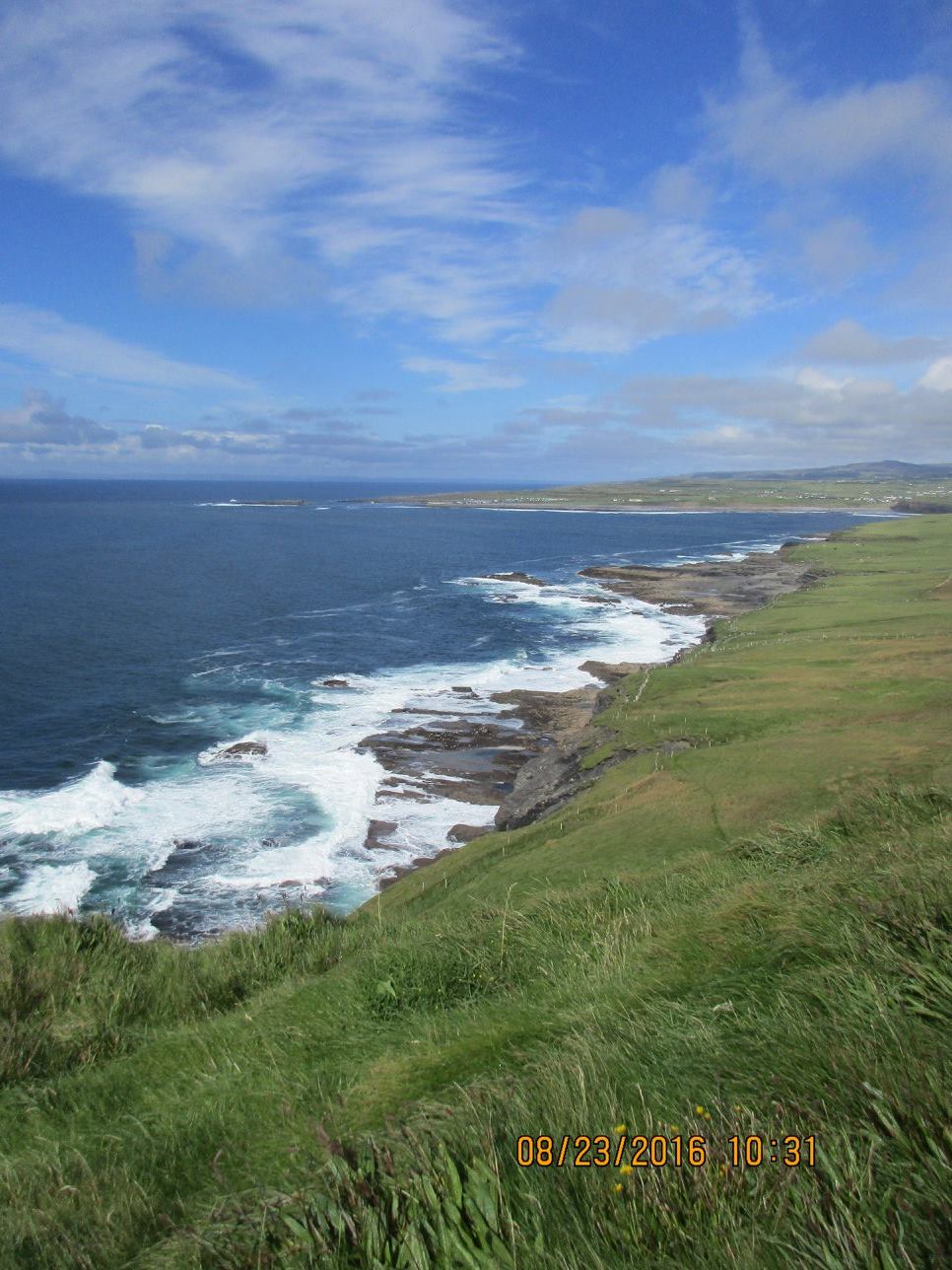
After roaming around the park itself, our group met up with our trail guide for a guided hike around the edges of the cliffs. Our guide, a young teenage boy, walked our group over a three hour hike down the western edge of the cliffs to the town of Doolin. After about 5 minutes, the other tourists throughout the park dwindled away, leaving the five of us to enjoy the beautiful afternoon. Again, if you are intending to do this tour, make sure you have sound shoes that can keep your feet dry and clothes that can get mucky. Our group was able to stop and take pictures when we felt like it, dangle our feet out over the sides of the cliffs, and learn about the local area from our guide. When we finally reached the bottom of the hike, we hopped on a tour boat to see the cliffs from the ocean.
While still interesting, if you intend to see the cliffs from both the ocean and on top, take your cruise first. Our group was rather exhausted by the time we climbed onto the boat, and we were left with a general feeling of "meh" when we finally saw them from the water.
 |
| The Cliffs of Moher from the Ocean |
The Ring of Skellig
Our next day trip took us to another part of Co. Kerry, the Ring of Skellig. If the name is at all familiar, it may be because this area is where part of the newest Star Wars was filmed (and every tourist shop, pub, and friendly person will let you know how they were a part of it).

 |
| Part of our mountain pass trip to Skellig |
The Unnamed Castle
 |
| Peering through the window |
Along our journey around the Ring of Skellig, we missed one of our stops and left on a whim to my favorite part of the entire trip. Out in the middle of a field, with no signage or fences, and a little gravel pull off on the side of the highway was an unnamed castle ruin. This castle, bounded by a cattle field on one side, and a peat marsh on the other, remains open to view. We were able to walk up and around it, climb the stairs to see the upper floors, and peer out at the surrounding countryside from its windows. While we were there, a family of four stopped, hopped out of their car, climbed up, and ate their picnic right in the castle. To be so close to history, and have it be so quiet, calm, and remote, was simply amazing.
The "Absurdly Beautiful Cliffs of Kerry"

Our next stop was to something that we had seen in our guidebook and were surprised at the name. The "Absurdly Beautiful Cliffs of Kerry" seemed like they must be some sort of overstated tourist trap. What we found was an amazing and absurdly beautiful set of cliffs. These cliffs, unlike the Cliffs of Moher, were not a tourist trap at all. Well manicured pathways with guard rails take you right out to the edge of these cliffs and allow you to view one of Ireland's UNESCO world heritage sites, the Skellig Islands.

Also at the top of these 1000 ft cliffs are views of the surrounding peninsula and several recreation "beehive" homes which monks prepared by stacking shale into huts to fend off the wind and rain. The mountain roads to and from the cliffs are windy, winding, and at times treacherous, but if you can handle them, it is well worth the drive. Plus, you might just get to have some close encounters with local farm animals.
 |
| The trip back from Skellig. Note the sheep on the road, and the oncoming vehicles pulled off to let us through. |
Castle Blarney
 |
| Blarney Castle |
One tourist trap that we had to see during our journey was Castle Blarney. Described by Frommer's as the winner of "cheesiest tourist attraction in Ireland," I was shocked at how not overwhelming the cheesiness was. Instead, what we found was a well manicured estate and castle with touristy quirks throughout and plenty of signs describing the scenery and lore around the property.
 |
| The Manor House |
We again forewent any formal guided tour as a part of our visit, but instead wandered through the gardens, castle, and even some stables (be sure to see the "unicorn"). Rather than campy, the signage and folks seemed to generally have a good sense of humor about themselves. Some parts, such as kissing the Blarney Stone are goofy tradition.
Others, such as the descriptions of what various rooms in the castle were used for and the opportunity to climb to the castle's towers were pure experiential history.
Dingle Brewing Company
 |
| I was terrified not of falling the ten stories down, but of throwing my back out. |
 |
| I for one would not have fit well for fighting in Blarney. I was standing on the bottom of the steps up to this doorway, about 2 feet below the bottom of it. |
Dingle Brewing Company


Our last day in Ireland we visited the town of Dingle. Most of this jaunt was shopping and eating, but one place we did have the chance to stop and tour was the Dingle Brewing Company. This particular stop was unlike anything I have ever seen before, and I found it to be an amazing opportunity to discuss the difference between American sites and Irish sites. I didn't take any pictures inside, but will try to describe our experience.
When you first walk in, you are greeted with a tiny pub like many in Ireland. The barkeep, standing in a bar which resembles a wooden life raft smiles and asks you if you'd like a pint and to take the tour. If you answer yes, he asks you around to his side of the serving bar in order to learn how to pour the perfect pint of their beer, Tom Crean's (more on that later).
Once you're done being harassed by the locals for your terrible form (as its the middle of the early evening and they're all laughing at your attempt), the bartender walks you over to a side door. "Okay, well you just walk down this little sidewalk and through the green door."
We try to set our drinks down. "What're you doing? Take em with you. Just drop the glass off when you're done."
We step inside into the middle of an operational craft brewery, with people bustling about carrying hops and jugs of ingredients. On the wall are posters, describing each of the stages in brewing in three languages with photos and explanations of the science behind the production.
Moving down, in the same room, are exhibits describing the history of brewing back to antiquity, and discussions of how manners and society are a reflection of alcoholic consumption through the ages. While not as formal as a museum, the exhibitions are well written, well edited, and provide a clear picture of historical events relevant to the history of beer. The next section, still in this large operational brewery is a history of the brewery itself (which is relatively short, as the company started in 2002). Lastly in this room is a large goofy picture of a pint glass with a hole for your head, and posters of everywhere in the world that the beer is sold (with patches from firefighters, police, servicemen, and even astronauts who have consumed their wares).
Stepping through a door leads you to the Tom Crean room. At this juncture, it is important to note that this is not Tom Crean the basketball coach at Indiana University, but instead is Tom Crean the Antarctic explorer who travelled with Ernest Shackleton. In this 12'x25' room is a timeline of Crean's life, explorations, and death. Also included are posters describing the fates of every single ship Crean worked on and ledger books from his business ventures in the early 1900s through the 1930s. The posters are professionally done and describe Crean's life, fortunes, troubles, and eventual death. The ledger books, along with a diary, sit out on a shelf for any visitors (keep in mind most have drinks with them) to flip through as they see fit.
The final room includes a large boiler, and materials related to the brewery's former occupants, a creamery. Posters describe the process of turning milk into cream and other products, the use of different types of equipment, and the financial troubles which led to the creamery being closed. Just like both of the previous rooms, not only are their exhibitions on posters, but the equipment and documents related to the business are available to pick up, look through, and explore.
While all of the exhibitions tend to skew in favor of their subject matter, they all include documentation and areas for further research. The exhibitions were structured in such a way as to interest our varied backgrounds (history, science, arts, and IT). For myself, this was a very impressive and welcome step to be taken by a company which is still so relatively young.
Concluding Thoughts
 |
| The view out of our window where we were staying. It's alright, you can be jealous. |
Our trip to Ireland was a fantastic opportunity which we had been looking forward to for a lifetime. It was a welcome chance to step away from several months of intensive researching and writing on my thesis and several articles. It was also an opportunity to see how another country preserves and shares its historical resources. While books on history and museums are still well received here in the States, Ireland provided the opportunity to see how folks who are surrounded by imposing history everyday adjust to it. Every single gas station I went into had not only current newspapers, but also weekly historical newspapers which discussed events in the nation's past. Every pub we walked into had signs, people, or both that described the history of that business and the surrounding community. It was amazing to be in a place where both contemporary events and history are a part of everyday life. More than likely, my view is skewed by the places and people we saw. Perhaps they're not truly representative of the whole, but I like to think that they are. If so, I can be much more optimistic about our country's own future of dealing with the past.
Tuesday, June 7, 2016
Finding That Spark: Slogging Through Writer's Block
This post will be a bit different from anything that has gone up recently, which you might have noticed has been nothing. With the past semester's writing projects (including, I'm happy to report, three pending publications), I set aside writing on the blog in favor of academic work. Additionally, I've been struggling with perhaps the most difficult elements of thesis work, burnout and writer's block. So to that point, I'm going to outline roughly what projects I've been working on and what still lays ahead. My hope is to (1) provide an update for anyone who might be interested, (2) offer up some possible directions for future work — and to seek out potential collaborators on that work — and projects, and (3) to break through the latest round of writer's block by changing gears.
Publication Pending
Three of my recent projects are working their way through the printing pipeline. Each is a little different, and each one provided unique opportunities.
Cooperative Extension
The first of these publications provided the chance to look at two categories I don't typically work in: organizational and labor history. For this project, I looked at records from the Cooperative Extension Service in White County, IN. I outlined what these records can tell researchers about government programs during the Great Depression and how genealogists and family historians can use them to gain insight into the lives of ancestors. Along the way, I was fortunate to work with some records generated by one of my own ancestors, Ralph Alvin Chitty, who was one of the first C.E.S. Agents in Indiana, and for that matter, in the U.S. That research will reach print later this summer in the Indiana Historical Society's The Hoosier Genealogist: Connections.
Bible Records
Another publication analyzes the role of family bible records related to a mid-nineteenth century lawyer from Fountain County, Indiana. These records are discussed as a tool for genealogists as well as for other historians. These records are discussed in relation to using newspapers and campaign materials as sources for understanding political action in pre-twentieth century America. This article will be published sometime in early fall.
Historic Diaries
My third and final pending publication looks at using historic diaries as sources of finding names, as well as understanding social dynamics between individuals. The diary of interest relates to a teenage girl from Martin County, Indiana in the early 1930's. As a part of that work, I've indexed the names of individuals included within her diaries from the period. This article will be published sometime in early fall.
Completed, For Now: Paratext and Education
One of the most interesting projects I had the chance to work on this spring was a "big" history of paratextual development in European education. Spanning from ancient history to the mid-nineteenth centuries, this term project focused on how paratextual elements including typography, tables of contents, indicies, page numbers, and marginalia came to be incorporated to form what we now know as "academic" texts. Special emphasis was placed on how major educational figures over time would have experienced the texts that they studied and produced. I am hoping to post a more user-friendly version of that work at a later date.
Current Research
As to current projects, I have two major efforts, and a significant search for a permanent job, underway. Both still have significant hurdles ahead, but both hold the possibility of providing fascinating insights into twentieth-century America.
Understanding Factory Work During the Depression
The first project is using the diary of a young woman who worked for a shirt factory in Loogootee, IN to understand issues related to the private and working lives of Hoosiers during the Great Depression. The company she worked for had factories throughout the Midwest, and her experience provides a personal window into understanding the daily struggles of a working woman during that time.
Thesis: Public Intellectualism in the Early Cold War
This is the biggest project I've ever undertaken, I suppose as it should be. Though this project has morphed over time, the major theme has remained the same. My hope is to look at the milieu of public intellectuals in the early Cold War. While the topic does, as most of my family knows, involve fiction author Ray Bradbury, I will forgo explaining further at this point in time (namely so I don't invite a competing thesis or article).
Future Directions/False Starts
Along the way, there have been several false starts on projects which might provide interesting avenues for future research. Interesting prospects and possibilities exist when time permits. I'm happy to potentially collaborate on these projects, or for resources that might be of use.
Scouting in American Society
Being an Eagle Scout, I have long held an interest in scouting related materials, and think that working with those that I've managed to cobble together (including several decades of manuals, magazines, and field guides) might provide a unique opportunity to look at changes in American values.
Rural Electrification
A tangential topic to the aforementioned article on the Cooperative Extension Service, rural electrification was aided by CES under the auspices of the Tennessee Valley Authority and other New Deal programs. My hope is to look at both the impact this had on rural families as well as the lives of early employees of the electric co-op system.
Indiana's Fighting "Basketbrawlers"
While working on another project, I came across numerous references to riots and fights breaking out as a part of basketball games in Indiana. I'd like to go back and see if these incidents were limited to the court or if they occurred during other sporting events. I would also like to see what life was like for these players after they moved on from sporting.
Big Picture History in Daily Lives
In exploring several diaries while working on another project, I noticed recordings of what many people might consider to be "big" events (presidential elections, assassinations, scientific discoveries). I would like to go back and explore whether individuals' recordings of these types of events in diaries and other unpublished sources hold up over generations. Does the speed with which we now receive news change our perception of its importance to our everyday lives? Have we fundamentally altered the way we commemorate these events as individuals? Are our heat of the moment responses to major events any more accurate today than they were in centuries past? So many questions exist, and there seems to be a treasure trove waiting to be examined.
Records Retention Policies in Public Universities
In the category of what my wife calls "boring historian stuff" is an interest in looking at the records retention policies of public universities. I would like to try to look at this issue from multiple perspectives including from those of records producers, facility managers, administrators, privacy advocates, information technologists, and historians. While the topic may seem dry today, the retention (and disposal) of records changes what stories will be and can be explored by the historians of tomorrow. My hope is that this would lead to some form of policy recommendations for universities and other public institutions that try to balance stakeholders concerns.
Thursday, January 7, 2016
Audio Comparative Review: Nash and Jacoby
| -------------------------------- |  | |
Cover of ISI 30th Anniversary Edition
| -------------------------------- |
Cover of Basic Books 1982 Edition
|
Thursday, December 31, 2015
2015: Failure, Growth, Challenges, and Progress
2015 was a year of chaotic learning. The short piece below outlines some of the tasks which were a part of the year, and where I'm hoping to go in 2016.
Wednesday, December 16, 2015
Review of Murolo and Chitty's From the Folks Who Brought You the Weekend
Priscilla Murolo and A.B. Chitty.
From the Folks Who Brought You the
Weekend: A Short, Illustrated History of Labor in the United States. New
York: The New Press. 2001. xx + 364. Cloth.
“It was past time to compile these
insights into a new general history” (Murolo and Chitty, 2001: xi). This simple
line sums up one of the critical differences between From the Folks Who Brought You the Weekend and other scholarly
works addressing labor history in the United States. Murolo and Chitty’s work
is primarily a “general history,” in that its intention is not to provide an
analytic, philosophical, or theoretical monograph on the course of labor
history in the American nation. Instead, Folks
is a narrative history of the United States, with the working members of
society and their efforts highlighted throughout. The authors are careful to
state their objectives from the start with hopes to provide “a comprehensive
survey of U.S. history for the general reader...;” address that “the labor
movement itself had changed...” since the last major general history had
appeared; and finally, to correct what they saw as a defect in the American
educational enterprise, that “much of what we learn and teach in schools is
just not true” (Murolo and Chitty, 2001: xi-xii). Why is this relevant to
assessing the value of Folks with
regard to contemporary historiography? Without doing so, one risks unfairly
critiquing Murolo and Chitty for not creating something they never intended to
write.
Such unfair criticism would include
challenging the lack of citation throughout the book, parenthetical, footnoted,
or otherwise. While this indeed hinders readers from easily accessing the
direct sources of information from which the authors draw their examples,
incorporating them into this form of book hinders general readers and often
conflicts with the publishing standards many companies have with regard to
constructing monographs. In trying to create a review narrative for non-scholars,
at least for those interested in having their work read, authors must adapt to
the genre. This form exists in contrast to works focused on providing analysis
and theory; those works necessitate providing clear citation in order to allow
for verification and assessment by other scholars. Nelson Lichtenstein’s State of the Union: A Century of American
Labor (2002) and Alice Kessler-Harris’s Out
to Work: A History of Wage Earning Women in the United States (1982), both
impressive analytic monographs which are of great utility to future scholars,
include substantive citational and discursive notes to clarify and reinforce
their efforts. When writers of analyses, including Bruce Laurie’s Artisans Into Workers (1989), fail to
incorporate these mechanisms, their work is left open to challenge, loses some
credibility, and may be limited in its utility to researchers. Folks, meanwhile, is not intended for
such a purpose. Murolo and Chitty’s effort is instead focused on whetting the
appetites of readers to look more closely at labor history and how the
discipline can provide different perspectives on old, familiar, topics. When
discursive footnotes are included, they provide both a momentary outlet from
the central narrative, and again, stimulate interest for other areas to look.
What does lend credence to the author’s understanding of the topic is a generous
Suggested Readings section and fluent
narrative style.
This fluency comes from a
substantive background in issues of labor history. Murolo is a faculty member
in the Department of History at Sarah Lawrence College in Bronxville, NY, where
she is Director of the Women’s History Graduate Program. She has a PhD from
Yale University (1993), where she studied under noted labor historian David
Montgomery. Her other major monograph was The
Common Ground of Womanhood: Class, Gender, and Working Girls’ Clubs 1884-1923 (1993) Arthur Ben (A.B.)
Chitty is a Library Systems Officer and Higher Education Associate with Queens
College, City University of New York. Chitty has produced eight short books
analyzing topics as wide ranging as cities in the Southwest, university development
in the Reconstruction South, and an autobiography of bi-racial, illegitimate
child in Reconstruction Era Tennessee. They live in Yonkers, New York.
Murolo and Chitty use this
scholarly background to their advantage in Folks.
Their work is incredibly fluid and easily read, as they have the necessary
practice to present the larger historical components with solid prose that
feels well practiced (almost as if they are used to teaching the subject). The
two are careful to include a wide variety of peoples, especially during their
discussion of the colonial and Revolutionary periods, when general histories
often are predominantly from the perspective of white, rich, male voices.
Though this particular reader would have liked to see some referencing to the
source material for these characters, that interest is primarily to assuage
selfish curiosity, rather than scholarly expectation.
The inclusion of Joe Sacco’s
fascinating illustrations provides a stimulating experience in its own right,
and one could easily connect this history through cartoon to later historical
works employing the graphic narrative form, especially Ari Kellman and Jonathan
Fetter-Vorm’s recent Battle Lines: A
Graphic History of the Civil War (2015).
Reviews of the book were generally
favorable, and most, like Paul LeBlanc’s review in International Labor and Working Class History (Fall, 2004),
recognize that while the book is “hardly the last word on the story of the US
working class,” but it does give readers, “valuable knowledge, rich insights,
and challenging interpretations,” useful, “not only for those just learning
about US and labor history, but also for experienced hands who can benefit
from, and be stimulated by, a fresh and sometimes audacious retelling of the
story” (LeBlanc, 2004: 218). “Undoubtedly,” notes James Spady, reviewer for The Radical Teacher (Fall 2004),
“specialist researchers will object to elements of the narrative, theory, and
method implicit in the book” (Spady, 2004: 16). Indeed, objecting to these
elements is, in large part, what provides jobs for scholars. This book is not
for those readers though.
What general readers may struggle
with is a problem inherent to many analyses in labor history, alphabet soup. A
five-page section at the beginning of the book lays out a compendium of
government, corporate, and organizational and programmatic name abbreviations.
Even with this, readers may struggle to identify the difference between
subjects, and they may get a headache trying to ascertain how these pieces fit
together. This confusion, though, is not a problem created by Murolo and Chitty;
it is a by-product of the complex system they discuss.
The final chapter of the book is
one area in which this reviewer is uncertain. Murolo and Chitty bring their
analysis chronologically as close as is possible when producing a book. While
this would be unsurprising in a sociological, economic, or political science
text, its incorporation in a substantive chapter (rather than in the Epilogue)
is odd for a history text. One important considerations for historians attempting
to support their claims is by ensuring “historical distance” from their
subjects to preserve objectivity, that is, as Mark Phillips suggests in History Workshop Journal (Vol. 57,
2004), “in terms of emotional identification and detachment - and, by extension,
of the political or social loyalties that engage both historians and readers
with their stories” (Phillips, 2004, 127). The generally accepted exception to
this concept is in appended sections (particularly Epilogues, Codas, and the
like) where it is common for authors to highlight contemporary shifts and
concerns as areas for future scholarly inquiry. This may however, be an attempt
by the authors to represent their own advocacy for the study and importance of
labor history. Such advocacy is also a commonplace occurrence, particularly for
subfields seen as marginalized or shrinking, such as labor history.
This distance does not
substantially alter the utility or tone of the book. It is, rather, a
discursive difference in how one structures a history monograph (Itself
obviously a far from settled formulation, something the thousands of “how-to”
books available can attest to). Instead, this quirk provides an interesting
opportunity for a new edition, one which incorporates all of the chaos caused
by 9/11, the wars in Iraq and Afghanistan, the Great Recession, the Tea Party,
and our current era of income/wealth disparity. Perhaps, though, this would
simply reiterate the lack of distance inherent to “compiling” the insights of
contemporary history. It will certainly be interesting to see what makes the
cut for the next generation of “general labor history.”
Sunday, November 22, 2015
Review of Bruce Laurie's Artisans Into Workers (1989)
Bruce Laurie, Artisans Into Workers: Labor in
Nineteenth-Century America. Chicago: University of Illinois Press, 1989.
pp. 257. Includes Bibliographic Essay and Index.
*Note: Page numbers refer to Illini
Books Edition, 1997.
In 1989, when writing Artisans Into Workers, Bruce Laurie had
established himself as a historian interested in labor issues. Laurie graduated
from the University of Pittsburgh in 1971, having written his dissertation,
“The Working People of Philadelphia, 1827-1853” which studied modernist
laborers in America. By 1989, when Artisans
Into Workers came out, Laurie had edited one major work on the subject and
had successfully expanded his dissertation into a full-length monograph. Though
Laurie’s research interests later on in his career would grow into studying conservativism’s
development as well as abolitionism, at the time, he was primarily interested
in the connections between labor and society in nineteenth-century America.
These connections placed Laurie in the unique roll of being able to synthesize
earlier institutionally focused labor history and the “new social history” of
labor that was becoming popular at the time (indeed many of his reviewers noted
this attempt as novel) as well as the intellectual roots of American radicalism.
Friday, September 18, 2015
Releasing Classified Information: The Presidential Daily Briefs and Our Understanding of Cold War Decision Making
On Wednesday, September 16, 2015 the Central Intelligence Agency released 2,500 President's Daily Briefings (PDB).1 While this happened rather quietly for most Americans, it holds an amazing opportunity for those who are interested in presidential intellectual, political, military, intelligence, and institutional history (to name a few of the segments of historians). How can 2,500 redacted documents provide opportunity for so many researchers? To understand, one needs to have a primer about the documents themselves, as well as how intellectual historians work.
The President's Daily Briefing
Sunday, April 19, 2015
Dr. Stayput or: How I Learned to Stop Worrying and Love the Blogger
Many of the folks who I communicate with asked where I disappeared to from the end of January through the beginning of March with regard to A Historian Finding My Way, and you, my readers deserve a rational explanation. This post will explain what happened and where I'm intending to head in the future.
Wednesday, April 15, 2015
History Relevancy Campaign: Part 6: Our Future
Note: This is part 6 in an 8 part series on the History Relevancy Campaign, based on an article titled "The Value of History: Seven Ways It is Relevant" from Public History News Vol. 35, No. 1.
Note: Any quotes designated by an asterisk (*) come from that article.
Special thanks to the NCPH as inspiration for this series.
Note: Any quotes designated by an asterisk (*) come from that article.
Special thanks to the NCPH as inspiration for this series.
From the campaign's call to action: We believe that history --- both knowledge of the past and the practice of researching and making sense of what happened in the past --- is critically important to the wellbeing of individuals, communities, and the future of our nation.*
Our Future- Engaged Citizens-History Helps People Craft Better Solutions.*
Wednesday, April 1, 2015
Reasons for Delay
Greetings Readers,
Many apologies for the delay in continuing A Historian Finding My Way. Between illness, courses, and testing an alternative website, things have bogged down a bit. Never fear though, I will return soon.
Best wishes,
Ethan
Many apologies for the delay in continuing A Historian Finding My Way. Between illness, courses, and testing an alternative website, things have bogged down a bit. Never fear though, I will return soon.
Best wishes,
Ethan
Sunday, January 25, 2015
History Relevancy Campaign: Part 5 Our Communities (continued)
Note: This is part 5 in an 8 part series on the History Relevancy Campaign, based on an article titled "The Value of History: Seven Ways It is Relevant" from Public History News Vol. 35, No. 1.
Note: Any quotes designated by an asterisk (*) come from that article.
Special thanks to the NCPH as inspiration for this series.
Note: Any quotes designated by an asterisk (*) come from that article.
Special thanks to the NCPH as inspiration for this series.
From the campaign's call to action: We believe that history --- both knowledge of the past and the practice of researching and making sense of what happened in the past --- is critically important to the wellbeing of individuals, communities, and the future of our nation.*
Our Communities- 4. Economic Development- History is a catalyst for economic growth.*
Wednesday, January 7, 2015
History Relevancy Campaign: Part 4 Our Communities
Note: This is part 4 in an 8 part series on the History Relevancy Campaign, based on an article titled "The Value of History: Seven Ways It is Relevant" from Public History News Vol. 35, No. 1.
Note: Any quotes designated by an asterisk (*) come from that article.
Special thanks to the NCPH as inspiration for this series.
From the campaign's call to action: We believe that history --- both knowledge of the past and the practice of researching and making sense of what happened in the past --- is critically important to the wellbeing of individuals, communities, and the future of our nation.*
Our Communities- 3. Vital Places to Live and Work- History lays the groundwork for strong, resilient communities.*
Saturday, January 3, 2015
History Relevancy Campaign: Part 3 (Our Selves Continued)
Note: This is part 3 in an 8 part series on the History Relevancy Campaign, based on an article titled "The Value of History: Seven Ways It is Relevant" from Public History News Vol. 35, No. 1.
Note: Any quotes designated by an asterisk (*) come from that article.
Special thanks to the NCPH as inspiration for this series.
Note: Any quotes designated by an asterisk (*) come from that article.
Special thanks to the NCPH as inspiration for this series.
From the campaign's call to action: We believe that history --- both knowledge of the past and the practice of researching and making sense of what happened in the past --- is critically important to the wellbeing of individuals, communities, and the future of our nation.*
Our Selves- 2. Critical Skills- History teaches critical 21st century skills and independent thinking.*
Wednesday, December 31, 2014
History Relevancy Campaign Pt 2: Our Selves
Note: This is part 2 in an 8 part series on the History Relevancy Campaign, based on an article titled "The Value of History: Seven Ways It is Relevant" from Public History News Vol. 35, No. 1.
Note: Any quotes designated by an asterisk (*) come from that article.
Special thanks to the NCPH as inspiration for this series.
From the campaign's call to action: We believe that history --- both knowledge of the past and the practice of researching and making sense of what happened in the past --- is critically important to the wellbeing of individuals, communities, and the future of our nation.*
"Our Selves: 1. Identity- History nurtures personal identity in an intercultural world."*
 |
| One of many family reunions. |
Many individuals' first interactions with history are in the form of family get-together's. Reunions, holidays, special occasions, and birthdays allow us the opportunity to interact with the elder generations of our family who teach us about who we are and where we come from. These lessons help children form permanent attachments to their past and start to develop moral, political, and religious perspectives that will follow them the rest of their lives.
 |
| My father's side of the family. Grandma and I spent many a day looking at our family tree. |
 |
| My maternal grandparents and great-grandmother. Grandpa has a penchant for classic cars, Grandma has one for cooking, and Great-Grandma for sharing stories. |
Especially in the internet age, authentic information and life experiences are valuable. While most think that a grandparent's tales of how they met their spouse and that crazy day at the office are humorous, they miss the fact that each holds nuggets of information about finding the right person and developing work ethic. While the nuances of these values change over time, the basic foundations of citizenship and interpersonal relationships come from the tales from previous generations.
Two simple projects to explore how identity is shaped by history are by trying to make a family tree and a family crest.
Creating family trees (or genealogy for the sensitive) is a great, and inexpensive, opportunity for people to explore their own family history and to interact with family members. All that is required is a sheet of paper and a phone (although other resources are available depending on how sophisticated you'd like to be). My mother is fond of Ancestry.com and all the opportunities it provides. So far, we've traced back to the mid-seventeenth century with ours.
 |
| The first project my wife and I took up as a married couple was to make this family tree for our mothers. |
Another relatively inexpensive project is creating a family crest. Sometimes, you'll get lucky and one already exists. If not, you'll have to make one. This can also be a great option for families wishing to start anew with a crest that expresses the values they hold. Stephen Slater's The Complete Book of Heraldry: An international history of heraldry and its contemporary uses (2003) is a good place to begin this project. While the title implies otherwise, Slater's book is a pretty good read and provides a foundation in the theory, design, and history of crests in simple fashion. Again, these can be as simple as a drawing on a sheet of notebook paper, or a gigantic wood-burnt 4-H project.
 |
| Yes, I did make that. It's about 3' x 1 1/2'. No, I don't make them anymore. |
Activities such as these are simple ways that you can incorporate history into your life and help foster interest in younger generations. Taking simple steps to encourage your family members to interact will help lead to more fulfilling family functions that have a lasting impact on our collective future.
Subscribe to:
Posts (Atom)