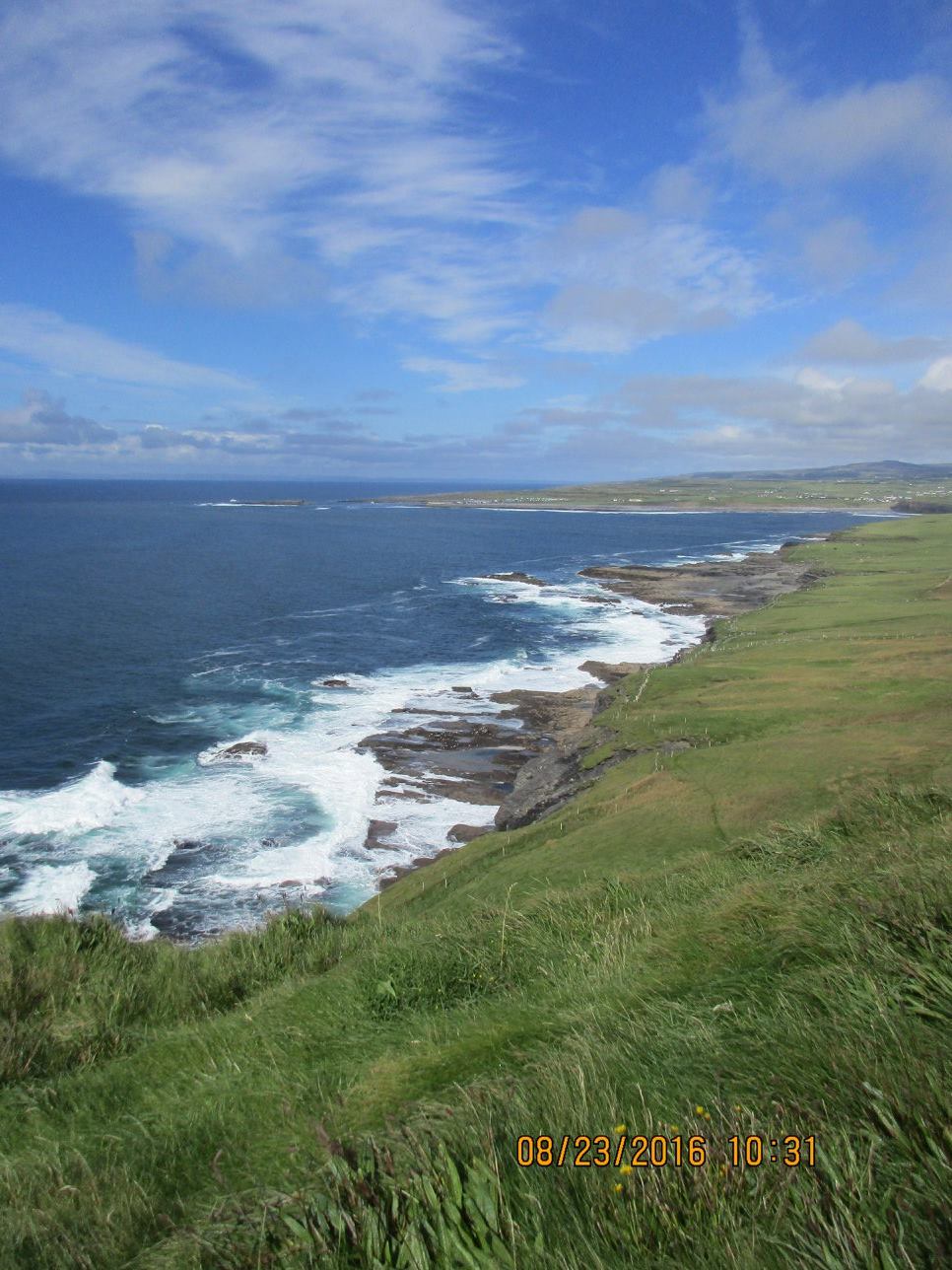
Many apologies to readers who have been waning over the past two months. After an intensive period of non-stop thesis work, my wife, several friends, and I had the opportunity to take a step back from the world and travel to Ireland. This post is the opportunity to one share some memories with family and friends, and to discuss a trend that I noticed in how the Irish approach access to the physical nature of their history. I'll try to highlight some of our adventures, and hopefully this will be an enjoyable review for family, friends, and fellow historians who might be contemplating a trip to the Emerald Isle.
I'll be following along the chronology of our journey, as any good historian would, so things might be a bit jumbled for those who don't follow along with the headers. And away we go...
Dublin: Our [Air]Port of Entry
We entered and left Ireland via Dublin International Airport, and thus spent our first full day and a half in Dublin itself. During our visit, we had the opportunity to walk around and visit several local stops, two publically tour-able businesses, and to enjoy a literary interlude. While we didn't go into several of the more famous sites (Christchurch Cathedral and St. Patrick's Cathedral), I'll discuss our experience with those we did.
The Brazen Head: Pubs and Food Experiences
 |
| The Brazen Head Pub, Established 1198 |
The Brazen Head was our first stop once arriving in Ireland. Ostensibly Dublin's oldest existing pub, being founded in the 12th Century, the Brazen Head was our first stop on an amazing journey through eateries large and small throughout the country. Rather than list every pub our small band visited, I'll take this opportunity to discuss the gastronomic experience in Ireland as a whole. Two primary lessons exist about eating (and drinking) in Ireland: First, always ask a local where they would go to eat if they had a free night off (or lunch or breakfast, whatever the case may be), and Second, don't be afraid to be adventurous. Portion sizes tend to be incredibly generous for the money you pay, and almost every gas station we stopped at had fresh fruits and fresh baked goods available (though most stations are closed between 9pm and 8 am).While fish and chips, Guinness stew, and shepard's pie are fantastic, sometimes the things you encounter will surprise you. Everything we ate on our tour (with the exception of airplane food, and one strange hamburger) was fantastic.
Many pubs, including the Brazen head will include outdoor seating (great except when it is raining, or windy, or most likely both). Another common feature is an accumulation of nicknacks and ephemera from basically any individual who has wandered in and stayed a while. We saw license plates from all over the U.S., old rock posters, a giant sculpture of a Newfoundland dog, and even one large wild goat's head which protruded out into our table. In almost every restaurant and pub we stopped at, there were locals who would stop by and strike up music with their own instruments (only one of which had a formal "music night"). In the larger cities and tourist destinations, most folks, other than Americans, don't tend to bother you too much, but in small villages and hamlets, expect anyone to saunter up and strike up a conversation. One of the best tips for a later stop we had was from an older lady who spoke with us over pints while listening to some beautiful fiddle playing.
Jameson Distillery

Begun in 1780 by John Jameson, the Old Jameson Distillery is a nice stop for anyone who is fond of Irish spirits. I should note that my experiences are related to the current setup for the distillery, but, as of September 1, 2016, the distillery will be closing down for renovations until March 2017. Tucked away off of a brick side street, the Old Distillery is an unassuming building other than the Jameson name on the side. You walk in through a gate into a patio ringed by restaurants, one of which is the front of Jameson. Upon entering, one is overtaken by the large wood and iron crossbars which support the building, a gigantic chandelier made of Jameson bottles, and a glass floor looking down into the rock walls of the old storehouse. A large portion of the location (other than the tours) is taken up by a gift shop and bar. Two of the distinct features involve the ability to purchase bottles (unsurprising for any distillery other than Jack Daniel's in dry Lynchburg, TN). One is the ability to purchase Jameson Distillery Reserve, a variety which can only be obtained in person at the distillery. Second is the ability to create your own bottle of Jameson, which involves choosing and filling your own bottle, and then placing your name, the bottle number, and date into Jameson's large ledger of bottles which have been produced. For those interested in whiskey, it is a truly unique experience.
Dublin Literary Pub Crawl
 |
| Wandering Through Dublin |
One of the most fun activities for groups touring Dublin is the Dublin Literary Pub Crawl. This tour is one of very few times that my wife described learning history and literature as fun. During the tour, two guides (local actors) guide the group through several stops and four pubs. At each stop and pub, the guides share literary history describing some of the works of Oscar Wilde, James Joyce, W. B. Yeats, Samuel Beckett, and others. Another key component is describing local and Irish history, particularly the 1916 Easter Uprising.
 |
| Trinity College Dublin, one of the stops |
The anecdotes are funny, the pubs are delightful, and the sights are beautiful. The tour itself takes about 2 1/2 hours, but could happily continue longer. At the end, there is a quiz for the whole tour group (of about 30 people), which even the least history minded persons can enjoy. Another tour which is offered by a partnering group is the Dublin Historical Pub Crawl, which is run by graduate students at Trinity College. Sadly, we didn't have time to try that one out. If it is anywhere near as good as the Literary Pub Crawl though, I have no doubts that it is fantastic.
Guinness Brewery and Storehouse
 |
| Guinness Barrels outside an exhibit on cooperage |
If St. Patrick's Day is the most famous thing in Ireland, then Guinness is a strong contender for second. This stop was the most like a museum that we entered during our time there. The main floor of the building is consumed by a gift shop the size of most strip mall stores in the U.S. In the center is an alcove which is in the shape of a five story tall pint glass. Arthur Gunness' 9,000 year lease for the property is prominently displayed under a glass plate in the center of this main floor for viewers to observe. The tour itself is self-guided, though video commentary by employees of the company help to usher visitors along and serve as entertaining captions for the objects on display. A relatively small portion of the tour itself has to do with the production of the beverage, but discussion of how to properly pour, and taste, Guinness are given large amounts of importance (though the tasting was rather unimpressive). One entire floor is devoted to the advertising history of the organization, and includes everything from the campiness of a fish riding a bicycle to the imposing view of a 270 degree theatre which plays Guiness' most artsy television commercials in booming surround sound.
 |
| Yes, really a fish (which moves) riding a bicycle. |
There are interesting avenues for the historically inclined to see museum quality exhibitions of materials related to the production of beer. A collection of the trains which were used for shuttling materials around the early brewery and an alcove describing the importance of cooperage (barrel construction for the lay person) stand as notable examples.
At the top of the brewery is a chance to have a pint of Guinness in a giant 360 degree glass rotunda. The view allows visitors to observe almost all of historic Dublin, with etchings describing prominent landmarks and tidbits of local history. Beware going on the weekend though (as we did), unless you don't mind having to push your way through throngs of people.
The Rock of Cashel
 |
| The Rock of Cashel |
After leaving Dublin, our group headed on to County Tipperary to visit the Rock of Cashel. While the exact date for the construction of the giant church is obscured (as it was built in several stages over the course of several centuries), it is believed to have been the castle for the ruling Munster's prior to becoming a church. Local lore suggests that the Munster's were converted by St. Patrick, and then these leaders turned over the Rock to the church. As with most everything, following signage to get to the Rock can be a bit tricky, but is well worth the effort.
 |
| Inside the Rock's Walls |
The entirety of the Rock is surrounded by rock walls, and their are two main buildings on the grounds, a large building which served as a chapel and kitchen area, as well as the church itself. Also inside the grounds is a cemetery. The entire complex is up on top of a large hill, and even once parking it is a bit of a hike to get up to the entrance. When we visited, the a large portion of the church was obscured by scaffolding and barriers, as their are current restoration efforts taking place. Their are formal tours of the property, but our group chose to roam unattended. Fortunately, the barriers within the church do a good job of describing what efforts are being undertaken in the restoration, and provide guidance as to the progress of the project. One component many visitors miss is the ability to go around some of the barriers (open, not climbing them) to see a fresco including a crucifix, St. Patrick, and the Virgin Mary, which is being restored in an alcove open for viewing. In the chapel of the smaller building, there is a ~20 minute documentary which describes the physical creation and maintenance of the structure, as well as a discussion of how the Rock fits into Ireland's theological and social history. The documentary, produced in part by UNESCO and the Heritage section of Ireland's Office of Public Works, is interesting, though at times may overemphasize the importance of the Rock's particular sect of Catholicism relative to Patrician and Benedictine traditions. From the back of the Church, one can look down onto the ruins of a former parsonage which serviced the Church (conveniently now a grazing field for sheep).
County Kerry
The vast majority of our time in Ireland was spent in County Kerry on the Southwest Corner of Ireland. The county itself is home to several regions of historical and natural interest, and has two large well-defined paths for touring. At this point, it is appropriate to mention that a guidebook or tour guide is essential to navigating safely some of these sites. In particular, it is important to note that on the Ring of Kerry (one of Ireland's most popular tour sets), one should always follow the flow of the professional tour groups (unless like ourselves, you wish to come around a blind mountain pass and find yourselves within inches of both cliffs and a tour bus). While this can be a bit of a drag for those with wanderlust, it will save your nerves.
Killarney National Park
Killarney National Park is the largest park in Ireland. A large portion of the historic sites which are on the Ring of Kerry are within its borders. If you have the ability to do so, setting aside an entire day or two to visit these locations is well worth the time.
Ross Castle
 |
| Ross Castle, a tower house next to the lake. For comparison, we are about 150 feet from the side of the castle. |
Our first stop on the Ring was Ross Castle, a restored tower house next to one of Killarney National Park's many lakes. This was our first stop at a castle and was thoroughly enjoyable. The outside of the castle, its pier, and boathouse are all open for free to wander through and are a neat perspective on this form of castle. Stepping inside, there is also a room which describes the history of the property, its role in the local culture, and a photo exhibition which explains how the building was restored. While a tour of the interior of the castle is available, our group wasn't particularly interested in following a guide, so instead we romped about on our own on the outside.
 |
| Ross Castle view from the woods surrounding the boathouse |
This is one of the opportunities to note a dramatic difference in the way that visitors are handled in the U.S. versus Ireland. While formal tours were available in most of the locations we visited, they were by no means the only way of seeing the sites. Instead, barring any graffiti or damage to property, visitors are allowed to freely roam on the sites. The above photo was taken when our group ventured out off of one of the roads leading to the Ross Castle boathouse, and if you don't mind getting muddy, the views are amazing. Our group could climb trees, wade through streams, fish, and skip rocks at our leisure. While their were areas cordoned off in some of the locations, for the most part, no one paid any mind to those wishing to climb stairs, walk on the parapets, or dangle over edges.
The Yellow Path to Torc Waterfall
 |
| The small falls above Torc Waterfall. |
Our next stop was to a trailhead around Torc Waterfall. The roadway to get there is a bit spooky (little more than a golf cart trail through the woods, which is two way traffic including tour busses and campers), and there are three paths available to visitors. Everyone in our group was comfortable in the outdoors and fairly capable athletically, so we chose to take the "moderate" yellow trail around the falls. Unless you are interested in making your pleasant hike into a climb/hike for cardio, don't try the red path. Even with the moderate path, we all had to stop several times to catch our breaths and to stretch. The views though are stunning and a great way to spend an afternoon.
 |
| One of the trail views of the lake. |
Regardless of the jaunt you take around the falls, you will need to leave plenty of time to get back to the parking lots. Each path is incredibly steep (in some places greater than a 45 degree incline), and the steps which have been added actually make the hike tougher than walking up the hillside. There are horse drawn carriages available to make your way through the park, but if you park in one of the lots near them be prepared to be badgered about taking one (we were glared at by one driver who would make a great timeshare salesman).
Ladies' View and Moll's Gap
The next two places we stopped were some of the most beautiful views any of our group had ever seen. That being said, to get there required some of the most harrowing road I have ever seen. The aforementioned close encounter with the tour bus occurred on this stretch and while it took us over an hour to make it up this craggy pass, coming down with the tour groups took only about 20 minutes.
The first stop was at Ladies' View, named after Queen Victoria's ladies in waiting who were astounded by its beauty during their tour of the country. When we got there, it was easy to understand their admiration.
 |
| Ladies' View |
There is a little shop and cafe at this point on the Ring, and from what I understand the milkshakes are fantastic (I was still hunting for the dramamine after our close encounter of the bus kind).
The next stop on this part of the Ring is called Moll's Gap, and it is at the very top of the mountain road which winds through the National Park. On the way to the Gap, you have the ability to pull off onto a dirt road and adopt a sheep, if you so choose. It too is an impressive sight, though some of the views from other mountain roads seemed more imposing to this tourist.
The trip back down from Moll's Gap as mentioned before was a much less strenuous one, particularly with a tour bus in front of us clearing the way. For the rest of the trip, any blind corner we encountered solicited shouts of "tour bus!" The trip back did allow us to see some of the things we missed on the way up, including a beautiful ruin of a church.
 |
| One of the sights along N71 on the Ring of Kerry |
More Natural Wonders: Doolin Cave and the Cliffs of Moher
Our adventure the next day put us in Doolin, County Clare. On this particular trip, we made stops at two natural wonders at opposite ends of the vertical spectrum. One was 250 ft into the depths of the earth, and the other was over 700 ft above the ocean.
Doolin Cave
 |
| The very "green" entrance to Doolin Cave |
Our morning tour was of Doolin Cave, and our arrival was greeted by laughing at two goats butting heads on top of the visitors' center. For those who have toured caves in the United States (like Mammoth in Kentucky), they may be underwhelmed at first by this particular cave system. Unlike the massive amounts of money funnelled into those areas, Doolin remains a privately owned and operated cave tour. When asked about any foreseeable problems with maintaining the cave, our guide stated that he was worried about "over-commercialization."

Doolin Cave is notable for being home to Europe's largest, and the world's second largest, stalactite. The cave is still active in that it has a running stream which goes through it, and as a result, the tour is both wet and muddy. If you're interested in visiting, make sure that you have a stout pair of shoes and clothes you don't mind getting dirty because its a slippery, goopey tour. The tour was fun, but the guide's continuous commentary about the greatness of this particular cave and encouragement to buy trinkets and food from the visitor center did wear thin pretty quickly.
Cliffs of Moher
The rest of our day in Co. Clare was spent around the Cliffs of Moher. This particular set of cliffs are made of limestone and sandstone, which is particularly susceptible to collapse (road cones and signs mark off areas of recent collapse along the pathways). The visitors' center reminded our group of the hobbit holes of Lord of the Rings, as it is a set of dugout shelters at the top of the cliffs. When you go to the Cliffs, there is an official path and an unofficial path. The official path is bounded by large slate barriers, about 30 feet off of the cliffside, and affords only the tall nice views of the cliff faces. That being said, the majority of visitors follow a well worn unofficial pathway which allows you to walk right out to the edge of the cliffs and peer over.

After roaming around the park itself, our group met up with our trail guide for a guided hike around the edges of the cliffs. Our guide, a young teenage boy, walked our group over a three hour hike down the western edge of the cliffs to the town of Doolin. After about 5 minutes, the other tourists throughout the park dwindled away, leaving the five of us to enjoy the beautiful afternoon. Again, if you are intending to do this tour, make sure you have sound shoes that can keep your feet dry and clothes that can get mucky. Our group was able to stop and take pictures when we felt like it, dangle our feet out over the sides of the cliffs, and learn about the local area from our guide. When we finally reached the bottom of the hike, we hopped on a tour boat to see the cliffs from the ocean.
 |
| The Cliffs of Moher from the Ocean |
While still interesting, if you intend to see the cliffs from both the ocean and on top, take your cruise first. Our group was rather exhausted by the time we climbed onto the boat, and we were left with a general feeling of "meh" when we finally saw them from the water.
The Ring of Skellig
Our next day trip took us to another part of Co. Kerry, the Ring of Skellig. If the name is at all familiar, it may be because this area is where part of the newest Star Wars was filmed (and every tourist shop, pub, and friendly person will let you know how they were a part of it).
 |
| Part of our mountain pass trip to Skellig |
The Unnamed Castle
 |
| Peering through the window |
Along our journey around the Ring of Skellig, we missed one of our stops and left on a whim to my favorite part of the entire trip. Out in the middle of a field, with no signage or fences, and a little gravel pull off on the side of the highway was an unnamed castle ruin. This castle, bounded by a cattle field on one side, and a peat marsh on the other, remains open to view. We were able to walk up and around it, climb the stairs to see the upper floors, and peer out at the surrounding countryside from its windows. While we were there, a family of four stopped, hopped out of their car, climbed up, and ate their picnic right in the castle. To be so close to history, and have it be so quiet, calm, and remote, was simply amazing.
The "Absurdly Beautiful Cliffs of Kerry"
Our next stop was to something that we had seen in our guidebook and were surprised at the name. The "Absurdly Beautiful Cliffs of Kerry" seemed like they must be some sort of overstated tourist trap. What we found was an amazing and absurdly beautiful set of cliffs. These cliffs, unlike the Cliffs of Moher, were not a tourist trap at all. Well manicured pathways with guard rails take you right out to the edge of these cliffs and allow you to view one of Ireland's UNESCO world heritage sites, the Skellig Islands.

Also at the top of these 1000 ft cliffs are views of the surrounding peninsula and several recreation "beehive" homes which monks prepared by stacking shale into huts to fend off the wind and rain. The mountain roads to and from the cliffs are windy, winding, and at times treacherous, but if you can handle them, it is well worth the drive. Plus, you might just get to have some close encounters with local farm animals.
 |
| The trip back from Skellig. Note the sheep on the road, and the oncoming vehicles pulled off to let us through. |
Castle Blarney
 |
| Blarney Castle |
One tourist trap that we had to see during our journey was Castle Blarney. Described by Frommer's as the winner of "cheesiest tourist attraction in Ireland," I was shocked at how not overwhelming the cheesiness was. Instead, what we found was a well manicured estate and castle with touristy quirks throughout and plenty of signs describing the scenery and lore around the property.
 |
| The Manor House |
We again forewent any formal guided tour as a part of our visit, but instead wandered through the gardens, castle, and even some stables (be sure to see the "unicorn"). Rather than campy, the signage and folks seemed to generally have a good sense of humor about themselves. Some parts, such as kissing the Blarney Stone are goofy tradition.
 |
| I was terrified not of falling the ten stories down, but of throwing my back out. |
Others, such as the descriptions of what various rooms in the castle were used for and the opportunity to climb to the castle's towers were pure experiential history.
 |
| I for one would not have fit well for fighting in Blarney. I was standing on the bottom of the steps up to this doorway, about 2 feet below the bottom of it. |
Dingle Brewing Company
Our last day in Ireland we visited the town of Dingle. Most of this jaunt was shopping and eating, but one place we did have the chance to stop and tour was the Dingle Brewing Company. This particular stop was unlike anything I have ever seen before, and I found it to be an amazing opportunity to discuss the difference between American sites and Irish sites. I didn't take any pictures inside, but will try to describe our experience.
When you first walk in, you are greeted with a tiny pub like many in Ireland. The barkeep, standing in a bar which resembles a wooden life raft smiles and asks you if you'd like a pint and to take the tour. If you answer yes, he asks you around to his side of the serving bar in order to learn how to pour the perfect pint of their beer, Tom Crean's (more on that later).
Once you're done being harassed by the locals for your terrible form (as its the middle of the early evening and they're all laughing at your attempt), the bartender walks you over to a side door. "Okay, well you just walk down this little sidewalk and through the green door."
We try to set our drinks down. "What're you doing? Take em with you. Just drop the glass off when you're done."
We step inside into the middle of an operational craft brewery, with people bustling about carrying hops and jugs of ingredients. On the wall are posters, describing each of the stages in brewing in three languages with photos and explanations of the science behind the production.
Moving down, in the same room, are exhibits describing the history of brewing back to antiquity, and discussions of how manners and society are a reflection of alcoholic consumption through the ages. While not as formal as a museum, the exhibitions are well written, well edited, and provide a clear picture of historical events relevant to the history of beer. The next section, still in this large operational brewery is a history of the brewery itself (which is relatively short, as the company started in 2002). Lastly in this room is a large goofy picture of a pint glass with a hole for your head, and posters of everywhere in the world that the beer is sold (with patches from firefighters, police, servicemen, and even astronauts who have consumed their wares).
Stepping through a door leads you to the Tom Crean room. At this juncture, it is important to note that this is not Tom Crean the basketball coach at Indiana University, but instead is Tom Crean the Antarctic explorer who travelled with Ernest Shackleton. In this 12'x25' room is a timeline of Crean's life, explorations, and death. Also included are posters describing the fates of every single ship Crean worked on and ledger books from his business ventures in the early 1900s through the 1930s. The posters are professionally done and describe Crean's life, fortunes, troubles, and eventual death. The ledger books, along with a diary, sit out on a shelf for any visitors (keep in mind most have drinks with them) to flip through as they see fit.
The final room includes a large boiler, and materials related to the brewery's former occupants, a creamery. Posters describe the process of turning milk into cream and other products, the use of different types of equipment, and the financial troubles which led to the creamery being closed. Just like both of the previous rooms, not only are their exhibitions on posters, but the equipment and documents related to the business are available to pick up, look through, and explore.
While all of the exhibitions tend to skew in favor of their subject matter, they all include documentation and areas for further research. The exhibitions were structured in such a way as to interest our varied backgrounds (history, science, arts, and IT). For myself, this was a very impressive and welcome step to be taken by a company which is still so relatively young.
Concluding Thoughts
 |
| The view out of our window where we were staying. It's alright, you can be jealous. |
Our trip to Ireland was a fantastic opportunity which we had been looking forward to for a lifetime. It was a welcome chance to step away from several months of intensive researching and writing on my thesis and several articles. It was also an opportunity to see how another country preserves and shares its historical resources. While books on history and museums are still well received here in the States, Ireland provided the opportunity to see how folks who are surrounded by imposing history everyday adjust to it. Every single gas station I went into had not only current newspapers, but also weekly historical newspapers which discussed events in the nation's past. Every pub we walked into had signs, people, or both that described the history of that business and the surrounding community. It was amazing to be in a place where both contemporary events and history are a part of everyday life. More than likely, my view is skewed by the places and people we saw. Perhaps they're not truly representative of the whole, but I like to think that they are. If so, I can be much more optimistic about our country's own future of dealing with the past.